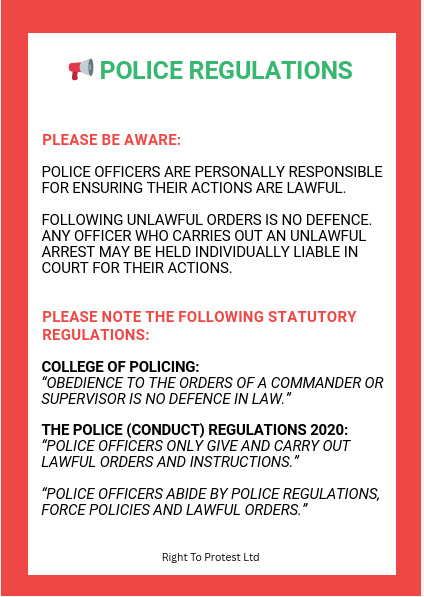
Right to Protest stands out strongly against the abuse of powers by the police. The police must follow the law when making arrests, and cannot make arrests with no legal basis. Should they do so, the arrest is unlawful. Despite this, the police have been increasing their arrests particular of anti-genocide protestors and those supporting the human rights of Palestinians including their rights under the Genocide Convention and Geneva Conventions.
Many of these arrests have resulted in no charges and where the CPS has attempted to prosecute, have resulted in no conviction. One example is the case of pregnant pro-Palestinian rights protestor, Marieha Hussain, who was arrested and prosecuted by authorities for what the judge agreed was a clearly politically satirical placard, which the prosecution had not proven was a crime.

Despite this, the London Metropolitan police (‘Met’) in particular continue to abuse their power in making demonstrably unlawful arrests.
Astonishingly, on 17 December 2025, the Met and Greater Manchester Police (‘GMP’) issued a statement informing the public that they would now begin arresting people for using the phrase “globalise the intifada” despite the fact that they acknowledged that the Crown Prosecution Service (‘CPS’) has made clear that the phrase on its own does not meet the legal threshold for prosecution:
“We have consistently been advised by the CPS that many of the phrases… don’t meet prosecution thresholds.”
In other words, the phrase is not, in itself, a criminal offence. Any arrest made solely on the basis of its use would therefore be without lawful foundation.
Yet despite this admission, the police have indicated that they nevertheless intend to proceed with arrests connected to the phrase. That amounts to the use of police powers beyond their lawful remit. When the law itself recognises that particular speech does not meet the criminal threshold, arresting individuals for that speech is an abuse of police powers. It represents the suppression of lawful political expression and an infringement of the fundamental rights of British citizens protected under the Human Rights Act 1998, including the rights to freedom of expression and peaceful assembly.
Ranjeet Brar, Director of the registered company, Right to Protest Ltd (not affiliated with this website), was arrested without basis in April 2026, following a speech he gave against the US-Israeli imperialist aggression against Iran, resulting in thousands of innocents murdered in Iran. His arrest was filmed:
Right to Protest reminds serving police officers that “we were just following orders” is not a defence recognised by law. If an arrest is unlawful, the officer who carries it out may be personally liable for that act. Compliance with an instruction does not render an unlawful arrest lawful, and officers are required to exercise their powers in accordance with the law.